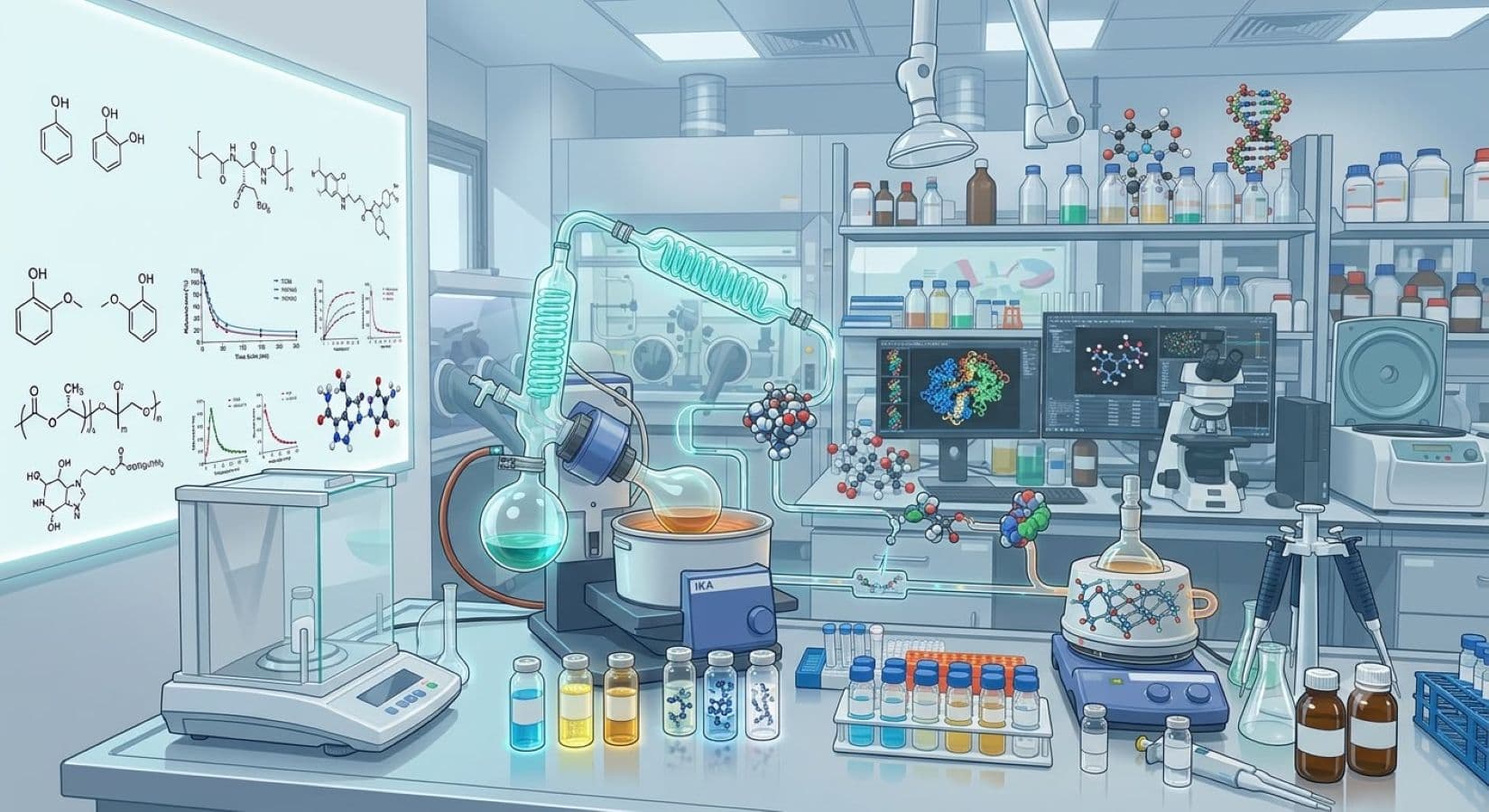
A research direction in Professor Avi Domb’s group focuses on the development of phenolate salts as a chemical strategy for modifying the physicochemical properties of phenolic and polyphenolic compounds. Many bioactive phenols and polyphenols exhibit limited aqueous solubility, which can restrict their formulation, absorption, and pharmaceutical applications. Formation of reversible phenolate salts provides an approach for modifying these properties while retaining the underlying molecular structure of the active compound.
The research involves the design and synthesis of phenolate salts with different counterions, followed by comprehensive chemical and physicochemical characterization. The resulting salts are evaluated in terms of molecular structure, aqueous solubility, stability, and their ability to regenerate the parent phenolic compound under appropriate conditions.
Beyond improving physicochemical properties, phenolate salt formation can be explored as a strategy for enhancing pharmaceutical delivery and expanding the applications of bioactive phenolic compounds. This approach has been investigated in the context of natural polyphenols and pharmaceutical excipients, as well as for molecules relevant to oral drug delivery.
An example of this approach is the development of SNAC phenolate salts, in which phenolate salt formation was investigated as a means of expanding the functionality of SNAC, a well-established absorption enhancer. Sodium, choline, and phosphatidylcholine phenolate salts were synthesized and characterized, and their potential application in the oral delivery of semaglutide was evaluated in vivo. The study demonstrated that phenolate salt formation can provide a new chemical strategy for modifying and extending the properties of functional phenolic molecules without fundamentally changing their molecular framework.
The research further extends to bioactive polyphenols, including naturally occurring compounds with potential pharmaceutical and biomedical applications. By combining medicinal chemistry, salt formation, pharmaceutical characterization, and drug delivery principles, this research aims to develop practical approaches for overcoming solubility and formulation limitations associated with poorly water-soluble phenolic compounds.
Overall, phenolate salt formation represents a versatile platform for improving the pharmaceutical properties of phenolic compounds and exploring new routes for their formulation and delivery, linking fundamental salt chemistry with pharmaceutical and biomedical applications.